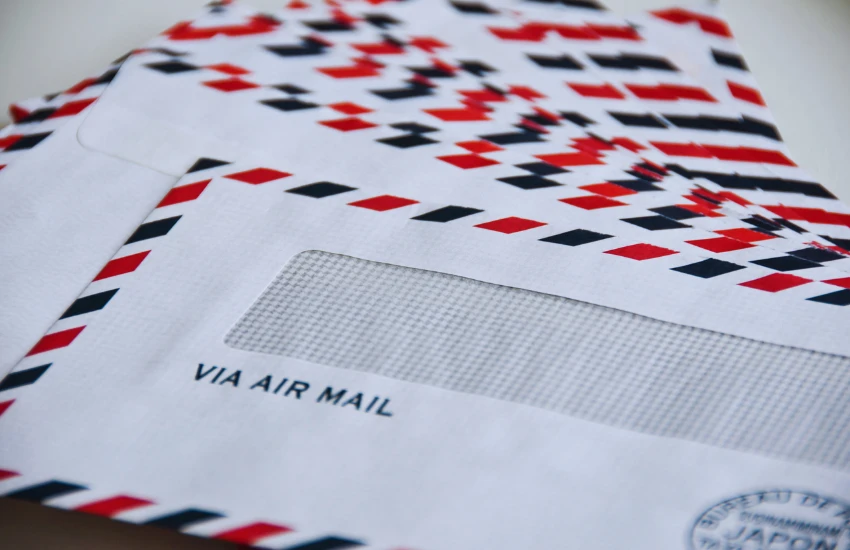
If you personalise envelopes or postcards as part of your customer communications, the way you apply names and addresses matters more than most teams realise. Many businesses still rely on adhesive labels because they feel simple and familiar. In high-volume mailing, however, labels often become the slower, more expensive option—and they can reduce the overall finish of the piece.
Wherever possible, inkjet personalisation, meaning printing variable data directly onto the envelope or postcard, is the smarter approach. It is typically faster in production, easier to control, and delivers a cleaner, more professional look that supports both brand perception and postal processing.
What “inkjet personalisation” actually means
Inkjet personalisation uses high-speed production inkjet equipment to print variable information—such as recipient names, addresses, barcodes, or reference codes—directly onto the mail piece. Instead of adding an extra component to the workflow, the personalisation happens as the envelope or postcard moves through the line.
By removing the label step, you reduce handling, minimise material waste, and simplify the overall production path. In a mail fulfilment environment where throughput and accuracy matter, that simplification can have a meaningful impact on both cost and turnaround time.
Why labels usually cost more than teams expect
Labels create hidden costs because they add an extra layer of materials and labour. Even if the label itself is inexpensive, the operational steps around it can slow production and increase the chance of errors.
Label workflows often require printing sheets or rolls, managing alignment, applying labels cleanly, and dealing with misfeeds or peeling edges. In busy runs, small label issues can create a chain reaction: reprints, manual fixes, delays, and higher waste. Over time, those “little” problems can become a significant cost driver.
Inkjet removes the label as a physical component, which means fewer steps, fewer consumables, and fewer opportunities for something to go wrong.
Speed and throughput: the practical production advantage
In direct mail operations, speed is rarely just about how fast a machine can print. It’s about how smoothly the whole line can run without stopping.
Labels can slow the line because they introduce an additional handling stage and can create bottlenecks. If the label application is even slightly inconsistent, the job may require more manual intervention. That may not matter for a small run, but it becomes noticeable as volumes grow or timelines tighten.
Inkjet personalisation is designed for continuous production. With correct setup and quality control, it supports consistent throughput while keeping the mail piece clean and uniform. That helps you hit dispatch windows with less stress and fewer last-minute fixes.
Quality and finish: why inkjet looks better on envelopes and postcards
The finish is where inkjet tends to win immediately. Direct printing usually looks cleaner because the address becomes part of the piece rather than something stuck on afterwards.
Labels can appear uneven, can trap air bubbles, and can shift slightly over time. On postcards, labels often look out of place and can interfere with the design. On envelopes, labels can create a “patch” effect that can reduce the premium feel of the mail piece.
Inkjet, by contrast, keeps the presentation consistent. It supports a more professional brand impression and can reduce the perception of mass-production, even when you are mailing at scale.
Reliability in mailing: fewer issues during handling and processing
Mail pieces go through handling, sorting, and transport. A label that lifts at the corner or wrinkles during handling can cause problems for scanning and routing. Even when items are delivered successfully, label imperfections can increase exception handling and reduce confidence in the process.
Direct inkjet printing avoids the risks associated with adhesive edges. The result is a mail piece that stays consistent throughout processing and remains easier to manage from production through delivery.
Data quality still matters, even with inkjet
Inkjet is not a shortcut around data quality. In fact, direct printing highlights data issues more quickly because the output is immediate and high volume.
If your addresses contain formatting inconsistencies, missing fields, or poor structure, the best print method in the world won’t protect the job. That is why strong data preparation is part of efficient personalisation.
A service like Clean Data and Management supports this by ensuring your database is cleaned, formatted, and ready for accurate personalisation and smoother mailing outcomes.
Where inkjet fits in the wider mail fulfilment workflow
Personalisation is rarely the only step. Most campaigns and operational mailings still require packing, inserting, sealing, or assembling multi-component communications. The more predictable the personalisation stage is, the easier the next stages become.
When the addressing is printed cleanly and consistently, it supports a smoother downstream workflow, particularly where envelope insertion or multi-format packing is involved. A service such as Pack Your Mailing aligns with this kind of operation when communications need to be packed into envelopes or boxes with quality and integrity maintained throughout.
When a label may still be necessary
Inkjet is often the best option, but there are cases where labels are still used. Some specialist materials may not accept ink well without testing. Certain coated surfaces, unusual finishes, or very specific production constraints may make a label unavoidable.
Even in those situations, the decision should be deliberate. The key point is that labels should not be the default choice simply because they are familiar. For most envelopes and many postcard formats, inkjet is the more efficient and professional option.
If you are personalising envelopes or postcards, inkjet printing directly onto the piece is usually cheaper, faster, and higher quality than using labels. It reduces materials, simplifies production, supports cleaner presentation, and often improves operational reliability.
The most effective approach is to treat personalisation as part of the full mailing workflow. When you pair direct printing with strong data readiness and predictable fulfilment processes, you get better outcomes on cost, timing, and finish—without adding complexity.